
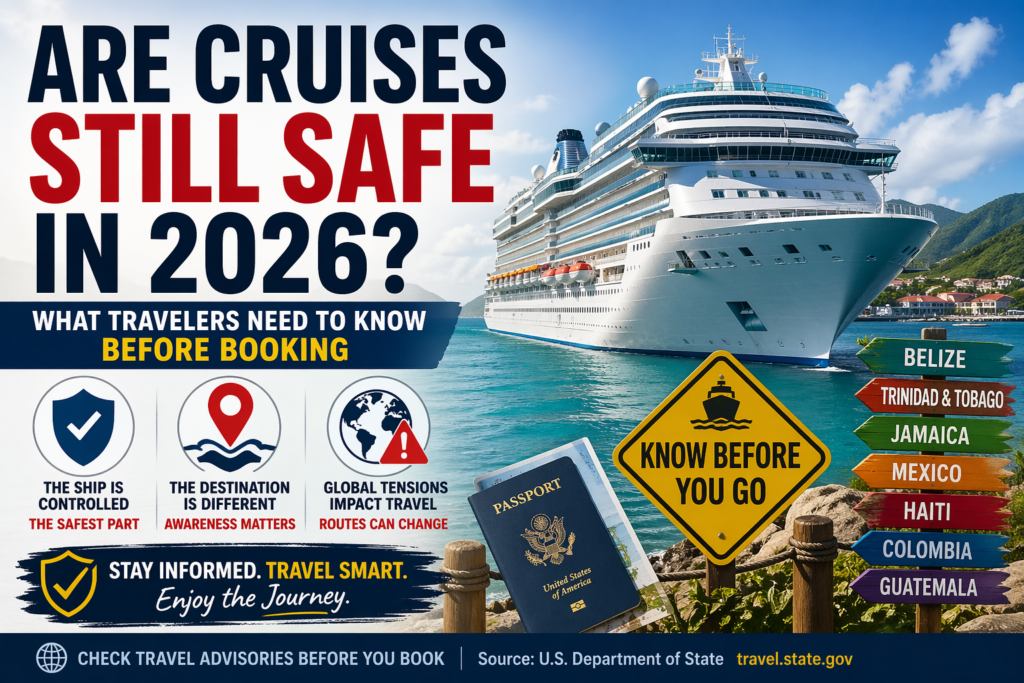
Are Cruises Safe in 2026 or Has Travel Changed?
Are cruises safe in 2026? It’s a question that now comes up before almost every booking. They picture safety onboard, security, and how the cruise itself operates. But in 2026, the bigger question is this:
What happens when you step off the ship?
Because that’s where the experience changes.
And right now, that difference matters more than it used to.
Global tensions are changing how cruise travel works
For many travelers, the real question isn’t just about booking—it’s whether cruises are safe in 2026 given how much travel has changed. Cruises haven’t stopped—but they have changed.
Recent global conflicts, especially in parts of the Middle East, have already started affecting cruise operations in ways travelers didn’t have to think about before.
Ships have been rerouted. Some have been delayed. Others have had to cancel stops entirely. In certain situations, cruise lines have even had vessels unable to leave ports as planned because of safety concerns.
At the same time, official travel advisories are encouraging Americans to exercise increased caution in different parts of the world. This doesn’t mean cruises are unsafe. But it does mean something important has shifted:
where you go now matters more than ever
The ship is controlled—the destination is not
One of the biggest misunderstandings about cruises is assuming the entire trip operates under the same level of safety.
It doesn’t.
Cruise ships are among the most controlled environments in travel. They follow strict international regulations, health protocols, and continuous monitoring systems. Serious onboard incidents remain extremely rare.
But once you step off the ship, you’re no longer in that controlled space.
You’re entering a destination that operates on its own conditions.
That’s where most of today’s concerns come from.
Not all cruise stops feel the same once you arrive
Some destinations feel smooth and familiar the moment you arrive.
Others require a different level of awareness.
Take Belize, for example.
It remains a popular cruise stop, and many travelers visit without any issues. But parts of Belize City—especially in the southern areas—have ongoing concerns related to gang activity.
For most cruise passengers, staying near the port or within organized excursions creates a controlled and safe experience.
The difference shows up when someone moves beyond those areas without understanding the environment. This is why many travelers are asking if cruises are safe in 2026 before choosing their destination.
The same pattern appears in other destinations.
Trinidad and Tobago has been flagged for more serious concerns, including violent crime and risks tied to kidnapping. This isn’t a place where unplanned exploring makes sense—how you move there matters.
Jamaica has improved in its advisory level, but that doesn’t mean it’s risk-free. Ports like Montego Bay and Kingston continue to welcome cruise travelers, yet conditions can shift depending on where you go beyond tourist zones.
Mexico adds another layer to the conversation. It’s one of the most common cruise regions, but it doesn’t operate as one single environment. Some ports, like Progreso, are generally calmer, while others connected to areas such as Mazatlán, Puerto Vallarta, and Manzanillo have faced ongoing security concerns in certain regions.
And then there are destinations like Haiti, which is currently under a Level 4 “Do Not Travel” advisory. This is one of the rare cases where cruise routes are often adjusted entirely because of instability.
Colombia and Guatemala fall into a different category. Both remain active travel destinations, but higher advisory levels reflect concerns around crime and incidents affecting tourists. The experience there often depends on whether travelers stay within structured excursions or move independently.
This doesn’t mean these places are off-limits.
It means the experience changes depending on how informed you are.
Why cruises feel less predictable right now
For many travelers, the concern isn’t safety on the ship.
It’s uncertain.
Cruises used to follow a set path. You booked an itinerary and expected it to stay that way.
Now, routes can shift depending on:
- global conflict
- port conditions
- safety advisories
Entire stops can be replaced or removed.
Some cruise lines have even canceled sailing seasons in certain regions because conditions changed too quickly.
So the real question has shifted from:
“Will I be safe?” to “Will my trip go as planned?”
Why cruise lines still include these destinations
This is where a lot of confusion comes in.
If there are risks, why are these destinations still part of cruise itineraries?
Because cruise travel is structured differently from independent travel.
Port areas are often more controlled. Excursions are designed with safety in mind. Tourism zones are supported in ways that surrounding areas may not be.
Cruise lines also monitor conditions closely and adjust when necessary.
So seeing a destination on your itinerary doesn’t mean nothing is happening there.
It means the experience is being managed—but not eliminated.
What this actually means for you as a traveler
This isn’t about fear.
It’s about understanding the difference between two environments:
the ship
the destination
Most issues don’t happen while you’re onboard.
They happen when travelers:
- move into unfamiliar areas without planning
- ignore local guidance
- assume every port operates the same way
That’s where awareness makes the biggest difference.
So… are cruises safe in 2026?
The honest answer is:
Yes—but with more awareness than before
Cruises are still considered safe, but cruise safety in 2026 depends more on where you go than ever before. Therefore, check that your next destination is:
✔ highly regulated
✔ statistically safe
✔ designed to protect passengers
But the world around them has changed.
And that affects:
- where you go
- how you travel
- and what to expect
If you’re planning a trip this year, it also helps to understand how to prepare for unexpected situations while traveling. How to Start Saving Money When You Feel Broke (2026 Guide)
Unexpected changes like rerouted cruises or cancellations can also impact your finances, especially if you’re not prepared ahead of time. Understanding if cruises are safe in 2026 comes down to knowing both the ship and the destinations you visit.
You can review current travel advisory levels directly through the U.S. Department of State before planning your trip. https://travel.state.gov/content/travel/en/traveladvisories/traveladvisories.html
Frequently Asked Questions
Are cruises safe in 2026?
Cruises are still considered one of the safest forms of travel when it comes to the onboard experience. Ships operate under strict international safety regulations and are closely monitored.
What has changed in 2026 is not the safety of the ship itself—but the conditions in certain destinations. That’s why travelers are paying more attention to where their cruise is going, not just the cruise itself.
Is it safe to get off the ship at every port?
In most cases, yes—but it depends on the destination and how you explore it.
Many cruise ports are designed with tourists in mind and are generally safe within those areas. The risk tends to increase when travelers move beyond those zones without planning or awareness.
Sticking with organized excursions or well-known areas can make a big difference in your experience.
Which cruise destinations require more caution right now?
Some destinations currently under higher travel advisories include areas in Belize City, Trinidad and Tobago, parts of Jamaica, certain regions in Mexico, Colombia, and Guatemala. Haiti is currently under a Level 4 “Do Not Travel” advisory.
This doesn’t automatically mean you shouldn’t cruise—it means understanding the environment before you arrive is more important than ever.
Why do cruise lines still go to these locations?
Cruise lines operate differently from independent travel.
They work within controlled port areas, organize structured excursions, and adjust routes when needed. A destination being included in a cruise itinerary usually means the experience is being managed—but not that conditions outside tourist areas are the same.
Can cruise itineraries change because of safety concerns?
Yes, and it’s happening more often than before.
Cruise lines may reroute, delay, or cancel stops depending on global events, safety advisories, or port conditions. That’s why flexibility has become an important part of cruise travel in 2026.
Let’s Talk About It (Engagement Section)
Travel looks different right now, and people are thinking more carefully about where they go and how they get there.
Some travelers are still booking cruises without hesitation. Others are taking more time to research destinations before deciding.
What about you?
Would you still take a cruise in 2026 knowing that some routes may change or require more awareness?
Or would you rather wait until things feel more predictable?
Have you ever been to any of the destinations mentioned—and what was your experience like?
Your perspective could help someone else make a better decision.
Final thoughts
Cruises haven’t suddenly become dangerous. But they have become more connected to what’s happening globally. The travelers who have the best experiences right now aren’t avoiding cruises.
That’s why more people are taking time to understand if cruises are safe in 2026 before making their final decision.
They’re preparing differently. Because the more you understand before you go. The more confident—and enjoyable—your trip will be.