
Purifying water during an emergency is one of the most important survival skills every household should understand. When disasters strike, access to safe drinking water can disappear quickly due to contamination, infrastructure damage, or power outages. Natural disasters such as hurricanes, floods, tornadoes, and earthquakes often disrupt municipal water systems, leaving entire communities without safe drinking water for days or even weeks. Power outages, infrastructure damage, or contamination warnings can also make normally safe tap water dangerous to consume.
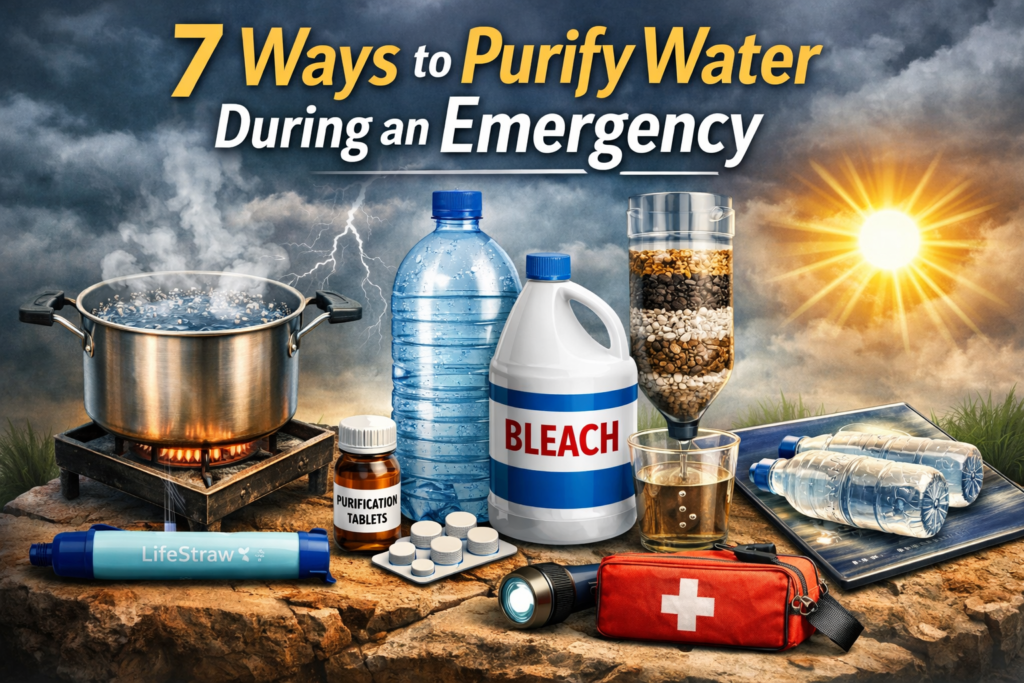
In situations like these, knowing how to purify water during an emergency can protect you and your family from serious illness.
Contaminated water can contain harmful microorganisms such as bacteria, viruses, and parasites. These organisms can cause illnesses like E. coli infection, giardia, cholera, and dysentery, which spread quickly when people drink unsafe water.
The good news is that several reliable methods can make questionable water safe to drink. Many of these methods use items you may already have at home, while others involve simple emergency tools that are easy to store in a preparedness kit.
Below are the most effective ways to purify water when clean drinking water is not readily available.
Why You Should Learn How to Purify Water During an Emergency
Boiling is widely considered the safest and simplest way to purify water during an emergency. Heat destroys most harmful microorganisms that cause waterborne illnesses, including bacteria, parasites, and many viruses.
To purify water using this method, place the water in a pot and bring it to a rolling boil. Once the water reaches a full boil, allow it to continue boiling for at least one minute. If you live at higher elevations, where water boils at a lower temperature, it is recommended to boil the water for three minutes to ensure it is fully disinfected.
After boiling, allow the water to cool naturally before drinking or storing it in clean containers.
While boiling is highly effective against biological contaminants, it does not remove chemicals, fuel contamination, or heavy metals. If the water source is suspected to contain chemical pollutants, additional filtration methods may be necessary.
Boiling works especially well for water collected from natural sources such as rivers, lakes, and rainwater, as well as tap water during a boil-water advisory.
Using Household Bleach to Disinfect Water
If boiling water is not possible due to lack of electricity or fuel, unscented household bleach can be used as an emergency disinfectant.
Bleach contains sodium hypochlorite, a chemical that kills many harmful microorganisms found in contaminated water. However, it is extremely important to use only plain, unscented bleach that does not contain added cleaners, fragrances, or color-safe formulas.
To disinfect water using bleach:
Add two drops of bleach per quart of clear water, or eight drops per gallon. Stir the mixture thoroughly and allow it to sit for at least 30 minutes.
After the waiting period, the water should have a faint chlorine smell. If it does not, repeat the process and allow it to sit for another 15 minutes.
Although this method may slightly affect the taste of the water, it can be a life-saving option when other purification methods are unavailable.
Portable Water Filters for Emergencies
Portable water filtration systems have become increasingly popular for emergency preparedness because they are lightweight, compact, and highly effective.
Many survival experts recommend keeping at least one portable filter in a household emergency kit. These filters are capable of removing bacteria, parasites, and sediment from water sources such as streams, ponds, and lakes.
Popular examples include straw-style filters, gravity filtration systems, and pump filters.
One advantage of these filters is that they can provide access to clean drinking water quickly without requiring fuel, electricity, or chemical treatment.
However, not all filters remove viruses, so it is important to review the specifications of any filtration device before relying on it during an emergency.
Solar Water Disinfection (Sunlight Method)
Another method sometimes used in survival situations is solar disinfection, commonly known as the SODIS method.
This process uses ultraviolet rays from sunlight to destroy harmful microorganisms in water. To use this method, fill a clear plastic bottle with water and place it in direct sunlight for approximately six hours.
The combination of heat and UV radiation helps neutralize many bacteria and parasites that may be present in the water.
While this technique can be useful when no other options are available, it works best in strong sunlight and may be less effective during cloudy weather or with highly contaminated water.
Emergency Water Storage Recommendations
Preparing before an emergency happens is always the best strategy. Emergency management agencies such as FEMA recommend storing at least one gallon of water per person per day.
For a family of four, that means storing at least 28 gallons of water for a two-week emergency supply.
Water should be stored in food-grade containers and kept in a cool, dark location. It is also important to periodically replace stored water every six months to ensure freshness.
In addition to storing water, many preparedness experts recommend keeping purification tools such as water filters, purification tablets, or unscented bleach as backup options.
When You Should Purify Water Immediately
There are several situations where you should always purify water before drinking it.
These include:
- After a flood or hurricane
- During a boil-water advisory
- When collecting water from lakes, rivers, or streams
- When traveling in remote areas
- During power outages affecting water treatment facilities
Even water that looks clear can still contain microscopic pathogens that cause illness, so purification is always recommended when the safety of the water is uncertain.
If you are preparing your home for emergencies, you may also want to read our guide on building a complete emergency preparedness kit:
https://everydayanswers.online/?p=792&preview=true
What FEMA and the CDC Recommend for Emergency Water Safety
When it comes to emergency preparedness, both the Federal Emergency Management Agency (FEMA) and the Centers for Disease Control and Prevention (CDC) emphasize that access to safe drinking water is one of the most important parts of disaster planning.
According to FEMA preparedness guidelines, every household should store at least one gallon of water per person per day for a minimum of three days, although many preparedness experts recommend storing two weeks of water whenever possible.
This supply should include water for:
- drinking
- food preparation
- basic sanitation
The CDC also provides guidance for situations when stored water runs out or when water sources become contaminated after disasters such as floods, hurricanes, or infrastructure damage.
The CDC recommends the following emergency water purification methods:
- Boiling water whenever possible to kill harmful microorganisms
- Using unscented household bleach in small amounts to disinfect water
- Using approved water purification tablets or filtration systems
Both agencies stress that clear water does not always mean safe water. Harmful bacteria and viruses are often invisible, which means purification is necessary anytime the safety of a water source is uncertain.
For the most current guidance on emergency water safety, you can visit:
- FEMA emergency preparedness resources
- CDC emergency water treatment guidance
These organizations provide trusted information used by emergency responders and disaster relief agencies across the United States.
Common Water Purification Mistakes People Make
During emergencies, people often rush to find drinking water, but mistakes in purification can still leave water unsafe. Understanding these common errors can help prevent serious health risks.
Assuming Clear Water Is Safe
One of the most common mistakes is believing that water that looks clean is safe to drink. In reality, many dangerous microorganisms are microscopic and cannot be seen with the naked eye.
Even clear water from a stream or lake can contain harmful bacteria, parasites, or viruses.
Not Boiling Water Long Enough
Another mistake is boiling water briefly instead of bringing it to a full rolling boil.
To properly disinfect water, it must remain at a rolling boil for at least one minute (or three minutes at higher elevations). Simply heating water or letting it simmer is not enough to kill all harmful pathogens.
Using the Wrong Type of Bleach
Many people do not realize that not all bleach is safe for disinfecting water.
Only plain, unscented household bleach that contains sodium hypochlorite should be used. Bleach with fragrances, additives, or cleaning agents can introduce harmful chemicals into the water.
Skipping Filtration When Water Is Dirty
If water is cloudy or contains visible debris, purification becomes less effective.
Before boiling or disinfecting water with bleach, it should be filtered through cloth, a coffee filter, or another clean material to remove sediment.
This allows purification methods to work more effectively.
Not Preparing Before an Emergency
One of the biggest mistakes is waiting until a disaster happens before thinking about water safety.
Emergency experts consistently recommend that households store clean drinking water ahead of time and keep basic purification tools available in an emergency kit.
Being prepared ahead of time can make a significant difference if access to clean water becomes limited.
Have You Ever Experienced a Water Emergency?
Water shortages can happen faster than many people expect. Storm damage, power failures, or infrastructure problems can leave communities without safe drinking water with little warning.
Have you ever had to purify water during an emergency or boil-water advisory?
Share your experience in the comments and let us know:
- What purification method did you use?
- Did you have emergency water stored ahead of time?
- What advice would you give others to stay prepared?
Your experience could help another reader stay safe during a future emergency.