
Where it Stands Amid Israel-Hamas, Ukraine/Russia & Iran Conflict — What Americans Need to Know Before Traveling
Published: March 2, 2026
U.S. travel advisory March 2026 updates are critical for Americans planning international travel amid rising global conflict.
The U.S. Travel Advisory March 2026 update highlights several regions experiencing increased conflict and security risks for American travelers.
For more guidance before traveling internationally, check out our full travel safety and preparedness recommendations to help you plan smart and stay safe.
As global tensions rise — from the Israel-Hamas war and the Russia-Ukraine war to increasing conflict between the U.S./Israel and Iran — many Americans are asking: Is it safe to travel abroad?
This guide gives the latest official U.S. travel advisory levels, what they mean, and clear precautions for Americans who still need to travel.
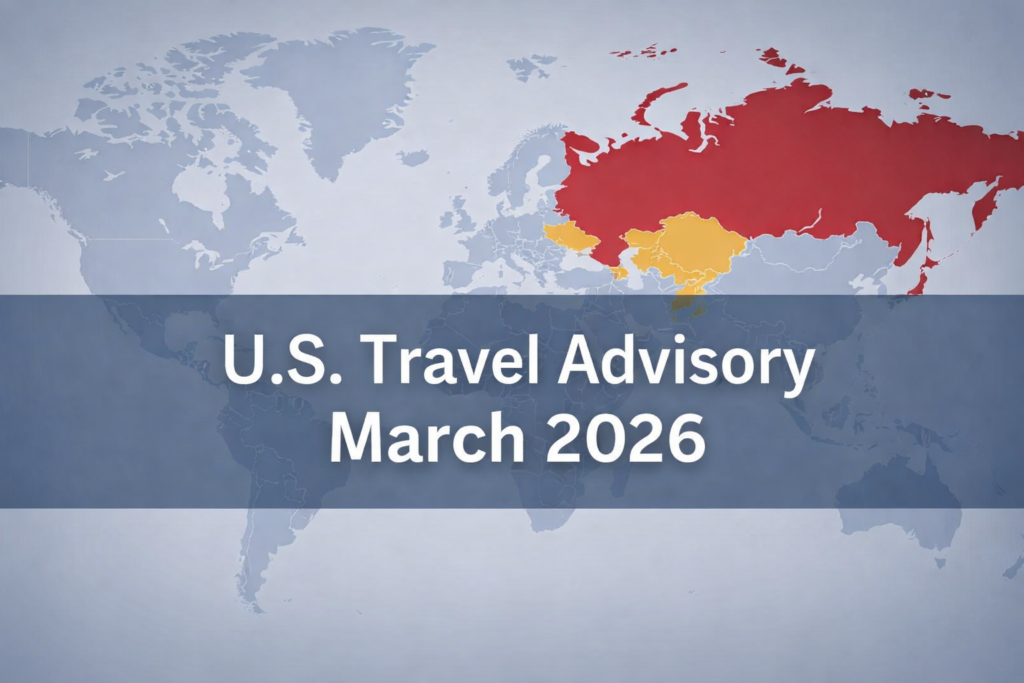
U.S. travel advisory March 2026 map of Middle East showing Level 4 and Level 3 countries
Image used for informational purposes related to international travel safety and advisories.
This graphic represents global travel advisory conditions and does not reflect official real-time government data.
How the U.S. Government Is Responding Right Now
The U.S. government considers the current global environment highly volatile:
- The U.S. is actively engaged in military operations involving Iran, with leaders describing the situation as a kind of “active war” scenario.
- There have been missile strikes and drone attacks affecting major travel hubs, including Dubai and other Gulf cities, leading to flight disruptions and some American travelers being stranded.
- Due to these conditions, the U.S. State Department expanded warnings, issuing a Worldwide Caution urging Americans everywhere to exercise increased caution when traveling internationally.
All travel advisories below are based on the most current guidance from the U.S. State Department. Visit their official site for the very latest before any travel — advisories can change quickly.
Travelers should also make sure their households are prepared for unexpected emergencies. Our guide on how to prepare for national emergencies in the United States provides practical steps families can take. https://everydayanswers.online/how-to-prepare-for-war-or-national-emergencies-in-the-united-states/
The current U.S. travel advisory March 2026 guidance reflects heightened tensions involving Iran, Israel, Ukraine, and surrounding regions.
Level 4 — Do Not Travel
U.S. authorities strongly advise Americans not to travel at all to these destinations due to war, terrorism, or lack of U.S. embassy support:
- 🇮🇷 Iran — Level 4: Do Not Travel
Ongoing conflict, threat of terrorism, and the absence of a U.S. embassy make travel extremely dangerous. - 🇮🇶 Iraq — Level 4: Do Not Travel
Active warfare, militia violence, and civil unrest present a severe threat to safety. - 🇸🇾 Syria — Level 4: Do Not Travel
Long-term war and terrorism risk continue unabated.
These regions pose the highest possible risk for American travelers. Avoid travel here.
Level 3 — Reconsider Travel
Travel is not banned, but the U.S. strongly advises against non-essential travel due to conflict spillover, civil unrest, or elevated security risks:
- 🇮🇱 Israel — Level 3: Reconsider Travel
The Israel-Hamas conflict and regional escalation — including threats from Iran — significantly raise danger levels. Americans abroad have been advised to leave while commercial flights still operate. - 🇶🇦 Qatar — Level 3: Reconsider Travel
Regional threats and missile activity have elevated the advisory. - 🇧🇭 Bahrain — Level 3: Reconsider Travel
Ongoing regional risk leads to higher caution levels.
Level 2 — Exercise Increased Caution
These destinations do not have active conflict zones within their borders, but regional instability and threats remain elevated:
- 🇦🇪 United Arab Emirates (including Dubai)
Level 2: Exercise Increased Caution
Missile and drone threats in the broader region have affected airspace safety and travel operations, leading to flight cancellations and disruptions.
What the Advisory Levels Really Mean
The U.S. Travel Advisory March 2026 classification system helps travelers understand the risk level of different destinations around the world. Countries are categorized into four advisory levels ranging from normal precautions to full travel restrictions. These levels allow Americans to evaluate security risks, political instability, terrorism threats, or health concerns before traveling internationally.
| Level | U.S. Government Message |
| Level 4 | Do Not Travel — Extremely dangerous; travel not recommended for any reason |
| Level 3 | Reconsider Travel — Serious risks exist; avoid unless absolutely necessary |
| Level 2 | Exercise Increased Caution — Some risk present; stay alert |
| Level 1 | Exercise Normal Precautions — Routine travel |
Why Advisory Levels Matter More During Active Conflict
Travel advisory levels are not political statements — they are risk assessments. During active war conditions, advisory levels may change faster than usual due to missile activity, terrorism threats, or regional spillover.
The U.S. travel advisory March 2026 warnings reflect not only direct combat zones but also indirect risks affecting nearby countries.
For current health and safety recommendations by destination, see the CDC’s travel health notices. https://wwwnc.cdc.gov/travel/notices
If You Must Travel — Practical Safety Checklist
Travel in or near conflict zones is inherently risky. If travel is essential, follow this checklist:
✈️ Before You Go
✔ Enroll in STEP (Smart Traveler Enrollment Program)
This keeps the U.S. Embassy informed of your presence and alerts you of safety updates.
✔ Check Embassy Alerts Daily Before Departure
U.S. Embassy websites and social media post real-time security warnings.
✔ Get Travel Insurance with Emergency Evacuation Coverage
Medical care and evacuation can be extremely costly in unstable regions.
✔ Plan Backup Transportation Routes
Know alternate airports and land exit routes in case airspace temporarily shuts down.
✔ Share Your Itinerary With Friends/Family
Make sure someone at home knows exactly where you’ll be.
According to the U.S. Department of State Travel Advisory system… https://travel.state.gov/en/international-travel/travel-advisories.html
While Abroad
✔ Follow Local Security Instructions Immediately
If authorities issue shelter-in-place orders — obey without delay.
✔ Avoid Public Gathering Areas
Areas with large crowds or high traffic may be targets for violence or unrest.
✔ Keep Essentials Accessible
Have food, water, medication, cash, and power banks with you in case services suddenly shut down.
✔ Stay Informed Hourly If Risk Rises
Download embassy alerts and official advisories on your phone — offline access helps.
If you must travel, you will want to enroll in the Smart Traveler Enrollment Program (STEP). Travelers can check the most current advisory levels directly through the U.S. Department of State travel advisory website. https://mytravel.state.gov/s/step
Tips for Americans Traveling During Periods of Global Tension
Travelers should remain calm but prepared when visiting international destinations during times of geopolitical uncertainty. Experts recommend taking several precautions before leaving the United States.
Some helpful steps include:
- Registering travel plans with the U.S. State Department through the Smart Traveler Enrollment Program (STEP)
- Keeping digital copies of passports and travel documents
- Monitoring official government travel advisories before departure
- Avoiding large public gatherings in unfamiliar locations
- Staying aware of local news and emergency alerts
These simple precautions can help travelers stay informed and respond quickly if conditions change while abroad.
How Airline Disruptions Are Affecting Travelers in 2026
The U.S. travel advisory March 2026 environment is also impacting international flight operations. Airlines may reroute flights to avoid restricted airspace, cancel routes with little notice, or temporarily suspend travel to certain destinations.
Travelers should:
- Confirm flight status 24–48 hours before departure
- Avoid tight layovers in politically unstable regions
- Consider refundable or flexible tickets
- Monitor airport closure announcements
Airspace restrictions during military escalation can change within hours. Being proactive reduces the risk of being stranded abroad.
To stay fully prepared for any trip, also review our latest safety alerts and recall updates — unexpected product recalls or health advisories can impact travel plans and packing essentials. https://everydayanswers.online/category/travel-safety-preparedness/
Final Takeaway
As conditions evolve, the U.S. travel advisory March 2026 status may change rapidly, so travelers should monitor official updates frequently.
International travel during this global conflict environment requires serious consideration and preparation.
- Do Not Travel to Level 4 countries.
- Reconsider Travel to Level 3 countries unless absolutely necessary.
- If travel is unavoidable — prepare with strong safety plans, real-time updates, and emergency contingencies.
For additional safety alerts and product recalls that may impact travelers and consumers, visit our Consumer Safety Alerts section. https://everydayanswers.online/category/recalls-safety-alerts/
Before planning international trips, always review the latest U.S. Travel Advisory March 2026 updates from official government sources.
Have you recently traveled internationally or changed travel plans due to safety concerns?
Share your thoughts or experiences in the comments to help other readers stay informed.
Frequently Asked Questions About the U.S. Travel Advisory
Q1: When do U.S. travel advisories change?
A: Travel advisories are updated by the U.S. State Department whenever new safety or diplomatic concerns arise — typically monthly or as conditions change.
Q2: How can I check travel advisories for my destination?
A: Visit the official U.S. Department of State travel advisory page linked above for the latest level and country-specific details.
Q3: Are health risks included in travel advisories?
A: Yes — health risks such as outbreaks or CDC notices often inform advisory levels and should be reviewed before travel.
Q4: Is it safe for Americans to travel internationally right now?
A: Travel safety depends on the destination and current security conditions. Travelers should always review the latest U.S. Department of State travel advisories, monitor international news, and register their trip through the Smart Traveler Enrollment Program (STEP) before traveling abroad.
Q5: What does a Level 4 travel advisory mean?
A: A Level 4 travel advisory means the U.S. Department of State advises Americans not to travel to that country due to high risk. This may include armed conflict, terrorism threats, civil unrest, crime, or serious health risks.