
Summer garden mistakes can sneak up on even the most careful gardener.
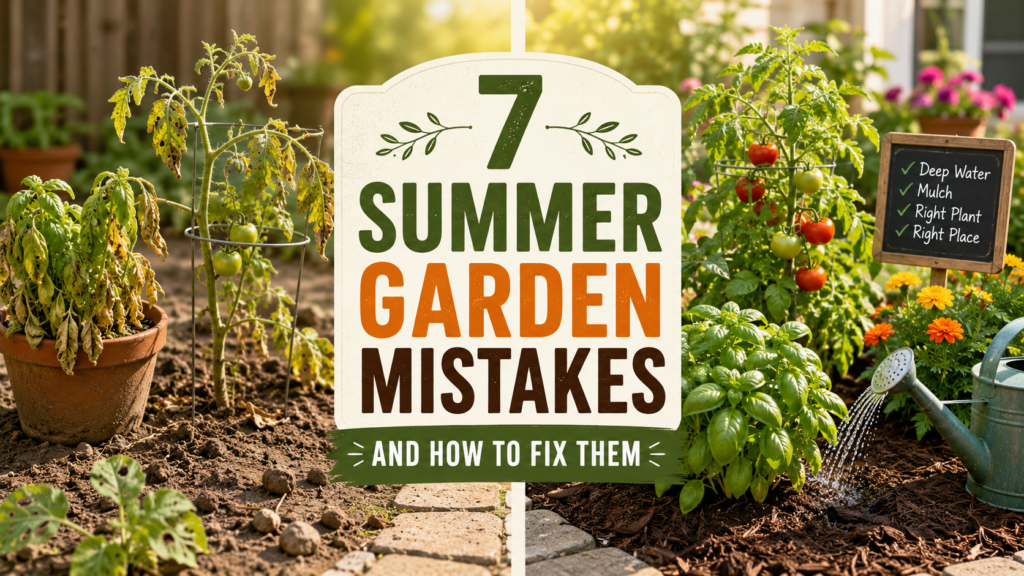
You can water faithfully, pick what looks like a sunny spot, buy healthy plants, and still end up with droopy basil, yellow leaves, stalled tomatoes, or flowers that never really thrive.
When that happens, it is easy to blame yourself and think you just have a “black thumb.” But most struggling plants are not caused by a lack of effort. They are usually caused by one or two small, fixable problems.
The hard part is that many summer garden mistakes look completely reasonable at first.
Watering on a schedule feels responsible. Planting extra seedlings feels smart. Skipping mulch feels harmless. Waiting a few days to deal with pests feels normal.
Then two or three weeks later, your plants start showing stress, and it feels like the whole garden is failing.
Before you give up on your basil, tomatoes, peppers, flowers, herbs, or container garden, check for these seven common summer garden mistakes and the simple fixes you can start using today.
FREE DOWNLOAD: The Garden Troubleshooting Checklist
A printable diagnostic guide to help you match your plant’s symptoms to the likely cause and the specific fix.
Mistake 1: Watering on a Schedule Instead of Checking the Soil
One of the most common summer garden mistakes is watering because it is “watering day” instead of checking whether the plant actually needs water.
This mistake can go in two directions.
Some gardeners overwater because they water every day just to be safe. Others underwater because they only water on certain days, even when the soil is already dry.
The real issue is not the calendar. The real issue is the soil.
A plant’s water needs can change quickly depending on heat, wind, sun exposure, container size, soil type, and how established the roots are.
That is why a fixed schedule does not always work.
The fix:
Before watering, stick your finger about two inches into the soil.
If the soil still feels moist, wait.
If the soil feels dry, water deeply.
A quick sprinkle on the surface is not enough. Light watering encourages shallow roots, and shallow roots dry out faster in summer heat.
Instead, water slowly so moisture reaches several inches down into the soil. Deep watering helps roots grow stronger and makes plants more resilient during hot weather.
A simple soil moisture meter can also help remove the guesswork if you do not want to rely on the finger test.
Mistake 2: Watering the Leaves Instead of the Soil
Another one of the most common summer garden mistakes is watering from above and soaking the leaves.
It may feel like you are refreshing the whole plant, but most plants need water at the roots, not all over the foliage.
Wet leaves can stay damp for hours, especially when plants are crowded or the weather is humid. That dampness can create conditions where fungal problems spread more easily.
Overhead watering can also waste water because some of it evaporates before it ever reaches the soil.
The fix:
Water at the base of the plant, directly onto the soil.
Try not to splash the leaves if you can avoid it. If you are watering a few pots or a small raised bed, a watering can or hose with a gentle setting works well.
For larger gardens, a soaker hose or drip irrigation system can help. These deliver water slowly to the root zone, reduce waste, and keep the leaves drier.
Mistake 3: Watering at the Wrong Time of Day
Watering at the wrong time is one of those summer garden mistakes that does not seem serious until the weather gets hot.
If you water during the hottest part of the afternoon, more water can evaporate before it reaches the roots.
If you water late in the evening, leaves may stay damp overnight, especially in humid weather. That can make disease problems more likely.
The fix:
Water in the early morning when possible.
Morning watering gives plants moisture before the heat builds. It also gives any water that lands on the leaves time to dry during the day.
If morning watering is not possible, water as close to the base of the plant as you can. The goal is to hydrate the roots without leaving the leaves wet for hours.
Mistake 4: Planting Too Much, Too Close Together
Packing too many plants into one space is one of the easiest summer garden mistakes to make.
It happens because small seedlings look innocent.
One more basil plant does not seem like a problem. Two more tomato plants feel like a better harvest. A few extra flowers make the space look full.
But once plants mature, overcrowding becomes a real issue.
Crowded plants compete for sunlight, nutrients, water, and airflow. Poor airflow also means leaves may stay damp longer after rain or watering, which can lead to more pest and disease problems.
The fix:
Follow the spacing instructions on seed packets and plant tags.
Those spacing recommendations are not random. They are based on how much room the plant needs when it reaches full size.
If your garden is already overcrowded, thin out the weakest plants or move what you can.
It may feel painful to remove healthy-looking plants, but fewer healthy plants usually produce more than too many stressed plants.
Three well-spaced tomato plants can easily outperform ten crowded ones.
Mistake 5: Choosing the Wrong Spot Based on Wishful Thinking
Choosing the wrong location is one of the sneakiest summer garden mistakes because the spot may look bright without getting enough direct sun.
This happens all the time with balconies, patios, side yards, raised beds near fences, and spaces blocked by trees, railings, sheds, or buildings.
You may think a space is sunny because it feels bright, but many fruiting vegetables need several hours of direct sun to perform well.
Tomatoes, peppers, eggplant, cucumbers, squash, and many flowering plants need strong sunlight to produce well. If they are only getting a few hours of true sun, they may grow leaves but struggle with flowers, fruit, or strong stems.
The fix:
Track your sunlight before planting.
Check the area in the morning, midday, and afternoon for a few days. Write down how many hours of direct sun the space actually gets.
Do not guess based on how bright the area feels.
Warm-season crops like tomatoes, peppers, eggplant, and squash usually need full sun. Leafy greens like lettuce, spinach, and some herbs can tolerate less direct light.
Once you know your real sunlight pattern, match the plant to the space instead of forcing the wrong plant into the wrong spot.
Mistake 6: Skipping Mulch
Skipping mulch is one of those summer garden mistakes that feels harmless at first.
Mulch may look decorative, but it does much more than make a garden bed look finished.
Bare soil heats up quickly in summer sun. It also dries out faster, which means your plants need more frequent watering and deal with more stress at the root level.
The fix:
Add a 2 to 3 inch layer of mulch around your plants.
Straw, shredded leaves, untreated grass clippings, and wood chips can all work depending on what you are growing.
Keep mulch slightly away from plant stems so moisture does not sit directly against them.
Mulch helps keep soil cooler, slows evaporation, reduces weeds, and protects the root zone during hot weather.
Once you start mulching consistently, you may notice that your garden holds moisture much better between watering.
Mistake 7: Waiting Too Long to Deal With Pests
Waiting too long to check for pests is one of the most frustrating summer garden mistakes because the damage can spread fast.
A few aphids on the underside of a leaf may not look like much. One tomato hornworm can be hard to spot. A few chewed leaves may seem harmless.
But pests multiply quickly in warm weather, and a small problem can become a much bigger one if you do not catch it early.
The mistake is not having pests. Every garden gets pests. The mistake is not checking often enough.
The fix:
Inspect your plants every day or every other day.
Look under leaves, along stems, near flower buds, and around new growth.
Watch for:
- Holes in leaves
- Curling leaves
- Sticky residue
- Yellowing or distorted growth
- Visible insects
- Caterpillar droppings
- Missing leaves or sudden damage
If you catch pests early, you usually have more options.
A strong spray of water can knock aphids off many plants. Larger pests, like tomato hornworms, can often be hand-picked in small home gardens.
For heavier pest problems, insecticidal soap, horticultural oil, neem oil, or another garden-safe product may help, depending on the pest and the plant.
Always read and follow the product label. Avoid spraying flowers when pollinators are active.
The Pattern Behind These Summer Garden Mistakes
The frustrating thing about summer garden mistakes is that most of them look responsible at first.
Watering every day feels careful.
Packing in more plants feels productive.
Skipping mulch feels like saving time.
Ignoring a few bugs feels harmless.
But plants usually do not react instantly. They show stress slowly.
That is why a garden can look fine one week and start struggling the next.
The good news is that most summer garden mistakes are fixable. You do not need to rip everything out or start over.
You just need to adjust the basics: water, sunlight, spacing, mulch, and daily observation.
Quick Summer Garden Mistakes Checklist
Use this quick checklist to troubleshoot your garden today:
- Check the soil before watering instead of watering on a fixed schedule.
- Water deeply so moisture reaches the root zone.
- Water at the base of the plant, not over the leaves.
- Water in the early morning when possible.
- Give plants enough space for airflow and mature growth.
- Track how much direct sun your garden actually gets.
- Add mulch to help hold moisture and protect the soil.
- Check leaves and stems often for early pest problems.
- Act quickly when you see damage, insects, or unusual plant stress.
For a printable version, download the free Garden Troubleshooting Checklist.
FAQ About Summer Garden Mistakes
My tomato leaves are curling. Is that one of these summer garden mistakes?
It can be.
Tomato leaf curl can happen for several reasons, including inconsistent watering, heat stress, pests, disease, or sudden environmental changes.
Start by checking the soil moisture. Then inspect the undersides of the leaves and stems for pests. Also look at whether the plant has enough space and airflow.
Do not assume it is only a watering issue until you check the whole plant.
Is it too late in the season to fix these summer garden mistakes?
No.
Most of these fixes can be started at any point in the season. You can adjust watering, add mulch, thin overcrowded plants, improve airflow, and start checking for pests right away.
Some plants may bounce back within a week or two. Others may take longer, depending on how stressed they already are.
Should I water my garden every day in summer?
Not always.
Some containers may need daily watering during hot weather, but in-ground gardens and raised beds should be checked first.
The best habit is to test the soil before watering. If the soil is still moist a couple inches down, wait. If it is dry, water deeply.
Is mulch safe for vegetable gardens?
Yes, mulch can be very helpful in vegetable gardens.
Use clean, untreated materials like straw, shredded leaves, dried grass clippings, or wood chips. Keep mulch slightly away from plant stems and avoid piling it too thickly against the base of the plant.
What is the easiest summer garden mistake to fix today?
Start with watering.
Check the soil, water at the base, and water in the morning when possible. These three small changes can make a big difference, especially during hot summer weather.
Your Turn
Which of these summer garden mistakes have you been making without realizing it?
Was it watering on a schedule? Skipping mulch? Planting too close together?
Drop a comment and share what has been happening in your garden. I genuinely want to know which mistake is most common, because I suspect watering on a schedule is the one catching the most people off guard.
And if you know another gardener who has been frustrated this season, share this with them. Sometimes one small fix is all it takes to turn a struggling garden around.
Final Thoughts
Gardening does not have to be perfect to be worth doing.
Every gardener makes mistakes. The key is learning how to read what your plants are trying to tell you.
Once you understand the most common summer garden mistakes, it becomes much easier to spot the problem early and fix it before your plants completely give up.
For a complete beginner’s guide to starting your first garden the right way, read:
How to Start Seeds Indoors Using Items You Already Have at Home
Happy gardening, even the imperfect kind.